

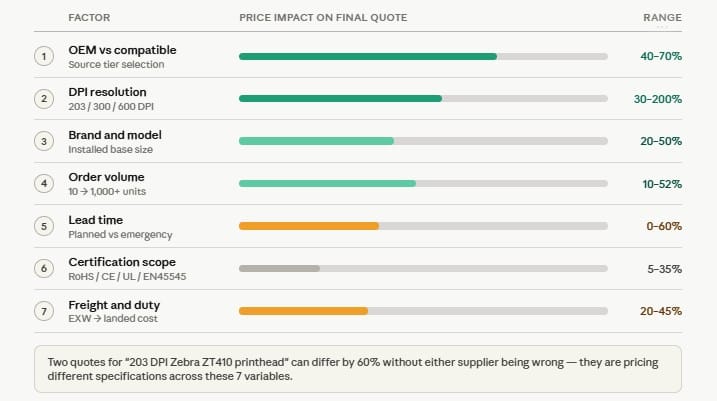
Two procurement teams sourcing the same printhead model — a 300 DPI replacement for a Zebra ZT410 — can receive quotes that differ by 60%. One team pays $85 per unit. The other pays $140. Neither is necessarily overpaying or being misled. The difference reflects seven variables that most RFQs fail to specify explicitly, leaving suppliers to fill in assumptions that favor their margin.
This guide breaks down each variable with price benchmarks, the cost logic behind it, and the specific RFQ language that removes ambiguity from your quotes.
Factor 1: OEM vs Compatible — The Largest Single Price Variable
The choice between OEM-genuine and compatible printheads accounts for a 40–70% price difference on equivalent models and is the first decision that determines your quote range.
OEM-genuine printheads are manufactured by or under direct license from the printer brand (Zebra, Honeywell, SATO, TSC, Datamax). They are sourced exclusively through the brand’s authorized distribution channel and carry the brand’s warranty — typically 90 days or the printer’s remaining warranty period. OEM pricing is not negotiable below the authorized distributor’s floor price; volume discounts are limited to 5–15% at most distribution tiers.
OEM-genuine price benchmarks (authorized distributor, 2025):
| Model | DPI | OEM unit price (1–9 units) | OEM unit price (10–49 units) |
|---|---|---|---|
| Zebra ZT410 | 203 DPI | $180–$220 | $160–$195 |
| Honeywell PM45 | 300 DPI | $195–$240 | $175–$215 |
| SATO CL6NX | 305 DPI | $210–$260 | $190–$235 |
| TSC TTP-2410M | 203 DPI | $95–$130 | $85–$115 |
| Datamax I-4212 | 203 DPI | $150–$190 | $135–$170 |
Compatible printheads are manufactured by third-party factories — primarily in China and Taiwan — using the same electrical interface, connector configuration, and dimensional specifications as the OEM unit. Quality ranges from near-OEM equivalence (with documented 100% electrical testing and resistance uniformity within ±3%) to low-grade assemblies with no QC documentation. Price reflects that range.
Compatible price benchmarks (direct factory, 50-unit MOQ, 2025):
| Model equivalent | DPI | Compatible unit price (50 units) | Compatible unit price (200+ units) |
|---|---|---|---|
| Zebra ZT410-equivalent | 203 DPI | $55–$75 | $45–$60 |
| Honeywell PM45-equivalent | 300 DPI | $65–$85 | $52–$70 |
| SATO CL6NX-equivalent | 305 DPI | $70–$95 | $58–$78 |
| TSC TTP-2410M-equivalent | 203 DPI | $30–$45 | $25–$36 |
| Datamax I-4212-equivalent | 203 DPI | $48–$68 | $38–$55 |
The price gap between OEM and compatible narrows significantly on total cost of ownership when compatible units are sourced from a qualified manufacturer with documented OQC. Hansprintec’s compatible printhead range covers 30+ printer brands with 100% electrical continuity testing per lot — the quality variable that most determines whether the price discount is real or deferred.
When OEM is justified: Printer manufacturer’s warranty requires OEM parts as a condition of coverage, the application involves medical or pharmaceutical labeling where component traceability is an audit requirement, or the printer is under a managed service contract with defined OEM part specifications.
When compatible is the correct specification: The printer is out of OEM warranty, the application is industrial or logistics labeling without regulatory traceability requirements, and the supplier provides documented lot-level electrical test data. At 200+ units per year, the cost difference between OEM and qualified compatible typically funds 1–2 additional headcount in the maintenance operation.
Factor 2: Resolution (DPI) — The Precision Premium
Print resolution determines the physical size of each heating element and the precision required in resistor fabrication, substrate flatness, and electrode routing. Higher DPI printheads cost more to manufacture and cost more at every supply chain tier.
The manufacturing cost logic: At 203 DPI, each heating element is 125μm wide. At 300 DPI, it is 84μm. At 600 DPI, it is 42μm. The photolithographic etching process that defines element geometry requires 3× tighter dimensional tolerance at 600 DPI versus 203 DPI — a manufacturing cost increase that flows directly into unit price.
DPI price premium benchmarks (compatible, equivalent model, 100-unit order):
| Resolution | Relative price vs 203 DPI | Typical application |
|---|---|---|
| 203 DPI | 1.0× (baseline) | Shipping labels, carton marking, standard barcode |
| 300 DPI | 1.3–1.6× | Retail labels, small barcode, compliance labels |
| 600 DPI | 2.2–3.0× | Pharmaceutical, fine-detail graphics, micro barcode |
A 300 DPI compatible printhead for a Zebra ZT410 priced at $65/unit would be equivalent to a 600 DPI unit at $140–$200/unit for the same model. The application must justify that premium — specifying 600 DPI for a standard carton shipping label wastes 2–3× the budget with no quality benefit.
The OEM-vs-compatible dynamic at high DPI: At 600 DPI, compatible manufacturing quality variance is higher than at 203 DPI, because tighter element geometry amplifies the effect of process variation. Resistance uniformity specifications (±3% for 600 DPI versus ±5% for 203 DPI) eliminate more units per production run. Source 600 DPI compatible printheads only from suppliers who provide per-unit resistance data — not lot-average data.
Factor 3: Printer Brand and Model — Why the Same DPI Costs Differently
Two 203 DPI printheads for different printer brands can differ in price by 50–100% despite identical resolution. The driver is not the printhead specification — it is the installed base size of the printer model and the resulting market structure around its replacement parts.
Installed base and price correlation: Zebra ZT-series and ZT400/ZT600 platforms have the largest global installed base of any industrial label printer. High installed base = high compatible printhead production volume = lower per-unit manufacturing cost amortization = lower price. TSC printers have a smaller installed base in North America and Europe; compatible pricing is higher per unit despite similar component specifications.
Brand price tiers (compatible, 100-unit order, 203 DPI):
| Brand tier | Examples | Compatible price range | Price driver |
|---|---|---|---|
| High-volume industrial | Zebra ZT/ZD series | $40–$75 | Largest global installed base |
| Mid-volume industrial | Honeywell PM/PC series, SATO CL/CT | $55–$95 | Strong installed base, regional concentration |
| Specialty / coding | Videojet, Markem, Domino | $80–$160 | Low volume, complex integration |
| Food retail / scale | Bizerba, Avery | $70–$130 | Niche installed base, fewer compatible suppliers |
| Entry-level industrial | TSC, Godex, CAB | $25–$55 | Price-sensitive market, thinner OEM margin |
Model generation matters within a brand. A Zebra ZT410 printhead and a Zebra 110Xi4 printhead are both 203 DPI Zebra industrial units — but the Xi4 is an older platform with declining installed base, and compatible pricing has risen as production volumes decrease. Always specify the exact model when requesting quotes; “Zebra 203 DPI printhead” is not a specification.
Hansprintec stocks compatible printheads across all major brand tiers: Zebra, Honeywell / Intermec, SATO, Datamax, TSC, Godex, Citizen, Videojet, Markem, Domino, Bizerba, Avery, CAB, and Toshiba.
Factor 4: Order Volume — The Discount Structure and Where It Breaks
Volume discounting on compatible printheads is real but non-linear. The discount structure has breakpoints where price drops significantly, and plateaus where additional volume adds minimal further reduction.
Typical discount structure (compatible, standard model, direct factory):
| Annual order volume | Unit price vs 10-unit benchmark | Additional leverage |
|---|---|---|
| 10–49 units | Baseline (0% discount) | None |
| 50–99 units | −10 to −15% | Sample cost credit |
| 100–199 units | −18 to −25% | Net 30 payment terms |
| 200–499 units | −25 to −35% | Private label option |
| 500–999 units | −33 to −42% | Priority production allocation |
| 1,000+ units | −40 to −52% | Annual framework pricing |
The sharpest discount breakpoints are at 50 units (where spot-buy pricing ends) and at 200 units (where suppliers begin offering program-level terms). The incremental discount from 500 to 1,000 units is smaller than the jump from 49 to 50 — the first volume threshold is the most important one to cross.
Consolidated ordering across models: A buyer purchasing 80 units of a Zebra ZT410-equivalent and 60 units of a Honeywell PM45-equivalent in separate RFQs gets 50–99 unit pricing on each (baseline). The same buyer who consolidates both models into a single order at one supplier receives 100–199 unit pricing on the combined 140 units — a 8–15% additional reduction with zero change in actual quantity.
Annual framework contracts lock in pricing at the highest volume tier regardless of the size of any individual release order. A buyer who consumes 300 units/year in 25-unit monthly releases gets spot pricing on each release without a framework — but negotiates 300-unit annual pricing with a framework agreement, saving 15–20% over the spot structure on equivalent total volume. The supplier benefits from demand predictability; the buyer benefits from price stability and allocation priority.
Factor 5: Lead Time Requirements — The Urgency Premium
Lead time is a direct cost variable in printhead wholesale pricing that most buyers treat as a service parameter. A supplier’s ability to meet a compressed delivery schedule requires either maintaining costly buffer inventory or rescheduling production — both of which carry real costs that suppliers price into expedited orders.
Standard vs expedited price premium benchmarks:
| Lead time requirement | Price premium vs standard | Notes |
|---|---|---|
| 8–12 weeks (planned production) | 0% (baseline) | Best price, supplier schedules at convenience |
| 4–6 weeks (standard stock) | 0–5% | Depends on stock availability |
| 2–3 weeks (priority production) | 8–15% | Requires production rescheduling |
| 1 week (emergency) | 20–35% | Air freight + premium handling |
| 3–5 days (critical) | 35–60%+ | Air freight mandatory, often not feasible |
The emergency price premium of 20–35% on unit cost compounds with air freight cost — which for a 50-unit printhead shipment from China can add $400–$800 to the order. On a $3,000 order, a stockout-driven emergency shipment can cost $1,200–$1,800 more than a planned replenishment order for the same quantity.
The buffer stock calculation that eliminates urgency premiums: Monthly consumption × supplier standard lead time in months × 1.5 safety factor. For a facility consuming 20 printheads per month with a 6-week lead time: 20 × 1.5 × 1.5 = 45 units minimum safety stock. The carrying cost of 45 units at $65/unit ($2,925 inventory value) is $175–$350/year at a 6–12% inventory carrying rate — a fraction of a single emergency shipment premium.
Thermal transfer ribbons and printer accessories follow the same lead time premium structure — coordinating replenishment schedules across consumables in a single order reduces both per-unit cost and freight frequency.
Factor 6: Certification Requirements — The Compliance Cost
Certification scope directly affects unit pricing because it determines the manufacturing and documentation processes the supplier must maintain. A printhead with CE + RoHS marking costs more to produce than an uncertified equivalent — and an EN 45545-2 railway-rated printhead costs more than a standard CE-marked unit.
Certification cost impact on unit pricing:
| Certification scope | Price premium vs no certification | Required for |
|---|---|---|
| RoHS only | +2–5% | Most markets, minimal testing |
| CE (LVD + RoHS) | +5–10% | EU, UK, Australia (RCM) |
| CE + UL recognition | +10–18% | US OEM integration |
| CE + ISO 9001 factory | +8–15% | Public procurement, institutional buyers |
| EN 45545-2 HL2 (railway) | +20–35% | Rail vehicle applications |
| Custom certification (DNV, BV) | +30–60% | Marine, offshore |
Verification requirement: Certification claimed in a quotation must be verified against the actual certificate before purchase. Request the certificate document — not a logo — with the issuing body name, certificate number, and expiry date. Cross-reference against the issuing body’s online registry. Fabricated CE declarations are common in the compatible components market; the cost of accepting one on a regulated application is replacement of the entire installation.
For standard industrial and logistics applications, CE + RoHS is the minimum acceptable specification. UL recognition is required for integration into UL 508A-listed control panels in the US market. Specify the exact certification standard in the RFQ — “CE certified” without a directive reference (LVD 2014/35/EU, EMC 2014/30/EU) does not define the test scope.
Factor 7: Freight and Customs — The Landed Cost Variables Most Quotes Ignore
The unit price in a supplier quotation is ex-works (EXW) or FOB origin in the majority of cases. The landed cost — the actual cost at your receiving dock — includes freight, insurance, import duty, customs brokerage, and inland delivery. For China-sourced printheads, this adds 20–45% to the EXW unit price depending on shipment mode and destination.
Incoterms and cost responsibility:
| Incoterm | Supplier pays | Buyer pays | Typical use |
|---|---|---|---|
| EXW (ex-works) | Nothing after production | All freight, customs, inland | Factory-direct, experienced importers |
| FOB (free on board) | Export clearance to port | Ocean/air freight, import customs, inland | Most China export transactions |
| CIF (cost, insurance, freight) | Ocean freight + insurance to destination port | Import customs + inland delivery | Convenient but less price-transparent |
| DDP (delivered duty paid) | All freight + customs to door | Nothing | Highest unit cost, lowest procurement complexity |
Freight cost benchmarks (China to US, 2025):
| Shipment size | Ocean freight (FCL/LCL) | Air freight | Price impact on 100-unit order |
|---|---|---|---|
| 100 units (~15kg) | LCL $180–$280 + customs | $320–$480 | +$3–$5 per unit (ocean); +$5–$8 per unit (air) |
| 500 units (~75kg) | LCL $320–$480 + customs | $800–$1,200 | +$1.6–$2.4 per unit (ocean); +$4–$6 per unit (air) |
| 2,000 units (~300kg) | FCL share $600–$900 + customs | $2,400–$3,600 | +$0.75–$1.20 per unit (ocean); +$3–$4.5 per unit (air) |
Import duty: Thermal printheads ship under HS Code 8443.99 (parts of printing machinery). US MFN duty rate: 0% for most origins. EU duty rate: 0% for most origins under MFN. Anti-dumping or Section 301 tariffs applicable to specific China-origin product categories can add 7.5–25% — verify the specific HTS code and applicable tariff schedule for your destination country before finalizing landed cost calculations. A printhead quoted at $65 EXW from China with a 25% Section 301 tariff has a landed cost of $97–$108 before any freight addition.
DDP as a simplification tool: For buyers without import infrastructure or for low-volume orders where customs brokerage fees exceed 10% of shipment value, DDP pricing from the supplier consolidates all cost variables into a single per-unit price. The premium over FOB is typically 8–15% — worth paying if it eliminates the administrative burden of managing customs clearance on multiple small shipments.
5 Negotiation Techniques That Reduce Bulk Printhead Pricing
Technique 1: Disaggregate the BOM and negotiate by volume tier. Most control panel and printer fleet BOMs contain 60–80% standard feed-through models (in printhead terms: one or two dominant printer models) and 20–40% specialty types. Quote the high-volume standard models separately from the specialty models — the volume concentration on the standard models crosses a discount threshold that blended quoting obscures.
Technique 2: Provide a purchase forecast, not just a purchase order. A non-binding 12-month forecast of “estimated 400 units across Model A and Model B” converts a spot buyer into a program buyer in the supplier’s pricing system. Suppliers price spot buyers at higher margins to compensate for demand uncertainty. A forecast shifts that calculus without committing you to specific quantities.
Technique 3: Use deposit percentage as a price lever. Offering 50% deposit versus the standard 30% deposit reduces the supplier’s working capital financing cost by approximately 0.3–0.5% per month on the uncommitted 20% differential. On a $10,000 order with a 90-day production cycle, that’s $45–$75 in real cost savings for the supplier — shareable as a 2–4% unit price reduction, particularly with smaller manufacturers where working capital cost is material.
Technique 4: Standardize the model specification. A buyer sourcing 8 different printhead models at 30 units each gets 30-unit pricing. Consolidating the printer fleet to 3–4 dominant models and sourcing 60–80 units each reaches the 50–199 unit pricing tier — unlocking 10–15% savings on equivalent total volume with no change to procurement budget.
Technique 5: Negotiate annual framework terms, not spot order terms. A 12-month blanket purchase order with quarterly releases locks in the annual-volume price tier regardless of individual release size. The supplier receives demand visibility and production planning efficiency; the buyer receives price certainty and allocation priority during constrained supply periods. Framework contracts add 5–10% price reduction over equivalent spot-order volume at the same annual quantity.
2025–2026 Market Price Reference
Current compatible printhead pricing for the most commonly sourced models, direct factory, EXW China, 100-unit orders (Q1 2025 benchmarks):
| Printer brand | Model | DPI | Compatible unit price (100 units) | OEM unit price (authorized distributor) |
|---|---|---|---|---|
| Zebra | ZT410 | 203 DPI | $52–$68 | $165–$195 |
| Zebra | ZT410 | 300 DPI | $72–$95 | $195–$230 |
| Honeywell | PM45 | 203 DPI | $58–$75 | $175–$210 |
| SATO | CL6NX | 305 DPI | $65–$85 | $195–$240 |
| TSC | TTP-2410M | 203 DPI | $28–$40 | $90–$120 |
| Datamax | I-4212 | 203 DPI | $45–$62 | $145–$180 |
| Citizen | CL-S521 | 203 DPI | $38–$52 | $120–$155 |
| Videojet | 6420 | 200 DPI | $88–$120 | $240–$310 |
These figures reflect direct factory pricing from qualified manufacturers with CE + RoHS certification and 100% electrical test documentation. Prices from trading companies or unqualified sources will appear lower — the cost differential reappears in incoming inspection failures, warranty claim disputes, and emergency replacement orders.
Pricing changes by 5–12% annually based on copper commodity pricing (contact assembly), PA66 resin availability (housing), and demand cycles in renewable energy and EV infrastructure that compete for the same component supply chains.
How Hansprintec Structures Bulk Pricing
Hansprintec provides thermal printhead wholesale pricing across the full brand and model range with transparent cost structure — no blended pricing that obscures the variables above.
Price structure:
- EXW China and CIF destination pricing available on request — landed cost comparison provided with every quotation above 50 units
- Volume tier pricing confirmed at quotation stage, not estimated from a website table
- Multi-model consolidated pricing for mixed-brand fleet orders
- Annual framework pricing available for buyers with documented 200+ unit annual consumption
Certification coverage: CE + RoHS standard on all models. ISO 9001 factory documentation available. EN 45545-2 HL2 variants available for railway applications on request.
QC documentation included with every shipment: 100% electrical continuity test report, lot-level resistance data (min/mean/max), and ESD packaging compliance confirmation — the documentation that transforms a price quote into a verifiable total cost of ownership figure.
Complementary consumables: Thermal transfer ribbons (wax, wax-resin, resin, and near-edge/TTO formulations) and platen roller kits are available for consolidated ordering alongside printhead replenishment — reducing freight frequency and improving per-unit logistics economics.
Submit a model list, annual volume estimate, and destination country to hansprintec.com/products for a structured quotation that separates unit price, certification scope, freight, and duty into comparable line items.
FAQ
Why do thermal printhead prices vary so much for the same model? Seven variables compound: OEM vs compatible source (40–70% impact), DPI resolution (30–200% premium at 600 DPI), printer brand installed base, order volume tier, lead time requirement, certification scope, and landed cost structure. Two quotes for “a 203 DPI Zebra ZT410 printhead” can reflect completely different specifications across these variables — the only way to compare them is to normalize all seven factors.
What is a fair price for a compatible Zebra ZT410 printhead at 100 units? A qualified compatible — CE + RoHS certified, 100% electrically tested, with lot-level resistance documentation — should price at $52–$68 per unit at 100-unit EXW from a direct manufacturer in 2025. Prices below $45 at this volume typically indicate reduced QC scope or uncertified components. Prices above $80 indicate either OEM-sourcing or trading company margin on top of factory pricing.
How much does bulk volume reduce the per-unit price? The sharpest discount is between 10-unit and 50-unit orders — typically 10–15%. The 100-unit to 200-unit step adds another 8–12%. Beyond 500 units, incremental discounts are 5–8% per volume tier. An annual framework contract at 1,000 units delivers 40–52% reduction versus 10-unit spot pricing on equivalent models.
Does certification add significant cost to printhead pricing? CE + RoHS adds 5–10% to compatible unit pricing over uncertified equivalents. UL recognition adds 10–18%. For standard industrial applications, CE + RoHS is the minimum specification and the cost is justified by the compliance documentation it provides. Accepting uncertified components to save 5–10% on unit cost creates regulatory and liability exposure that costs multiples of the saving if challenged during an audit.
How do I calculate the true landed cost of a printhead order? Start with EXW unit price × quantity. Add: ocean freight (LCL for orders under 200kg, FCL share above), import duty (verify the specific HTS classification and applicable tariff schedule for your destination), customs brokerage ($150–$350 per shipment), and inland delivery. For China-to-US orders in 2025, total landed cost is typically EXW price × 1.25–1.45 for ocean freight and × 1.35–1.55 for air freight, before any applicable Section 301 or anti-dumping tariffs.
