

The unit price difference between a qualified supplier and an unqualified one is rarely more than 15%. The cost difference after a failed lot — air-freight returns, production downtime, emergency sourcing, and re-inspection — routinely reaches 300–500% of the original order value. Supplier vetting is not a procurement formality; it is the decision that determines whether bulk pricing delivers actual savings or absorbs them.
This guide provides eight specific questions to ask any thermal printhead supplier before issuing a purchase order, the acceptable and unacceptable answers to each, and the red flags that disqualify a supplier regardless of pricing.
Question 1: Do You Manufacture or Trade?
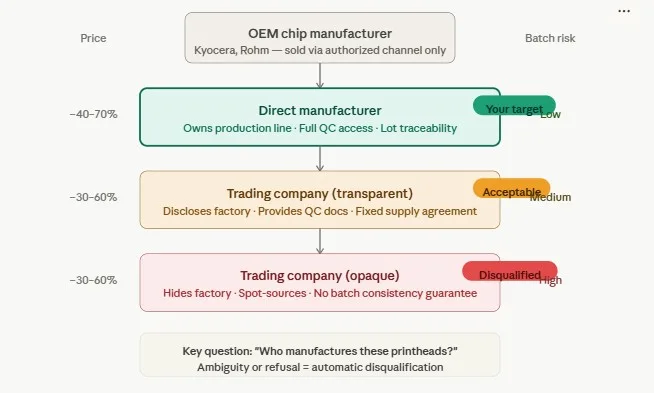
The first question establishes the supplier’s position in the supply chain — and therefore their ability to control quality, lead time, and pricing.
What to ask: “Are these printheads manufactured in your own facility, or do you source them from a third-party factory?”
Acceptable answers:
- Direct manufacturer: owns the production line, can provide factory registration documents, can support factory visits, and controls the QC process end-to-end
- Authorized trading company: explicitly identifies the manufacturing source, can provide the factory’s certification documents, and has a documented supply agreement
Unacceptable answer: Ambiguity. Any supplier who deflects this question — “we have our own production capabilities,” “we work with several factories” without identifying them — is concealing their supply chain position. That concealment prevents you from verifying quality at the source.
Verification step: Request the business license. Chinese manufacturers registered as manufacturing enterprise can be cross-referenced against the National Enterprise Credit Information Publicity System . Trading companies registered as Trading company are not disqualified — transparency is the requirement, not the business model.
Why it matters for printhead procurement specifically: A trading company with no fixed manufacturing source cannot guarantee lot-to-lot consistency. If their primary factory is at capacity, they source from a secondary factory with different resistor formulations and tooling — producing a lot that passes electrical test but delivers different print density than the approved sample. This is the most common quality failure in compatible thermal printhead procurement and the hardest to diagnose after the fact.
Question 2: What Certifications Does the Product Carry?
Certification scope determines where the printhead can be legally installed and whether it meets the compliance requirements of your end customers. It also provides indirect evidence of manufacturing discipline — factories that maintain third-party certification audits operate different quality systems than those without.
What to ask: “Which certifications apply to these specific printhead models — and can you provide the current certificates with expiry dates?”
Minimum acceptable certification scope by market:
| Market | Required | Common Additional |
|---|---|---|
| European Union | CE (LVD + RoHS) | REACH compliance |
| United States | RoHS (California Prop 65 for some channels) | UL recognition (for OEM integration) |
| Australia / NZ | RCM marking | — |
| Japan | PSE (for AC-powered assemblies) | — |
| GCC / Middle East | SASO / G-Mark | CE accepted in most cases |
What to verify: Request the actual certificate documents — not logos on a website. Verify certificate validity dates. CE self-declaration is legitimate for thermal printhead assemblies; third-party EN 55032 EMC test reports provide additional confidence. ISO 9001:2015 certification of the factory’s quality management system is a meaningful indicator of process control — request the certificate scope to confirm it covers printhead manufacturing, not an unrelated business unit.
Red flag: Certificates provided as low-resolution images without issuing body details, certificate numbers, or expiry dates are almost universally fabricated. Request the certificate number and verify directly with the issuing body.
Hansprintec supplies thermal printheads with CE, RoHS, and ISO documentation provided as standard on all orders — certificates are available for download or provided with shipment on request.
Question 3: What Is Your Monthly Production Capacity and How Do You Handle Peak Demand?
Capacity is not a standard RFQ question — which is why most procurement teams discover a supplier’s capacity constraints during their first peak-season delivery failure rather than before it.
What to ask: “What is your monthly production capacity for this printhead model? What was your production volume for this model in the last quarter? How do you manage allocation when demand exceeds capacity?”
Acceptable answers:
- Specific monthly unit figures with the ability to reference production records
- Clear explanation of allocation policy during constrained periods (existing customers prioritized, allocation by framework contract volume, etc.)
- Documented lead time extension policy — written commitment to notify buyers within 5 business days of any lead time change
Unacceptable answer: “We can meet any volume requirement” with no supporting production data. No factory has unlimited capacity. A supplier who claims unlimited availability either does not understand their own operations or is willing to overcommit and source from secondary suppliers to cover gaps — the scenario described in Question 1.
Capacity verification: Request the most recent three months of shipment records for the specific printhead model you intend to order, redacted for customer identity. If the supplier’s stated monthly capacity is 2,000 units and their shipment records show 1,800 units shipped in each of the last three months, they are operating near capacity. Factor that into your buffer stock calculation.
Seasonal demand pattern: Printhead demand peaks in Q3–Q4 in most markets (pre-holiday retail labeling volume, year-end industrial procurement cycles). If your ordering schedule places large orders in September–November, confirm allocation availability explicitly — do not assume standard lead times apply during peak periods.
Question 4: What Is Your Sample Policy?
The sample evaluation stage is where supplier qualification becomes empirical rather than documentary. A supplier’s sample policy reveals more about their confidence in product quality than any certification document.
What to ask: “Can you provide 3–5 production-lot samples — not showroom units — for the specific models I need? What is the cost, lead time, and whether sample cost is credited against the first production order?”
Acceptable sample policy structure:
- Production-lot samples (pulled from current stock or next production run, not pre-selected units)
- Sample cost: $15–$80 per unit depending on model complexity, credited in full against first order above MOQ
- Sample lead time: 3–7 days for stocked models; 2–5 weeks for non-stocked
- Sample documentation: resistance value and electrical test data included with each sample unit
Red flags in sample policy:
- Supplier declines to provide samples, offering instead “evaluation videos” or “test reports” — these do not substitute for physical evaluation in your target printer model
- Samples provided without any electrical test data — no resistance value, no continuity confirmation
- Sample lead time exceeding 6 weeks for a model the supplier claims to stock — indicates the model is not actually in production
- Sample units that arrive in non-ESD packaging — if the supplier does not protect samples, they will not protect production lots
Sample test protocol: Install each sample in the target printer model. Print a full-width 100% density test pattern at the printer’s default energy setting. Run a minimum 500 linear meters of the production media type. Document: missing dot count (acceptable: zero), print density uniformity across the full width (acceptable: no visible banding), and overglaze surface condition after 500m (acceptable: no visible wear or scratching). Any deviation from these criteria disqualifies the sample lot. Request replacement samples from a different production batch — if the second batch shows the same issue, the supplier’s process has a systematic problem.
Question 5: What Are Your Outgoing Quality Control Standards?
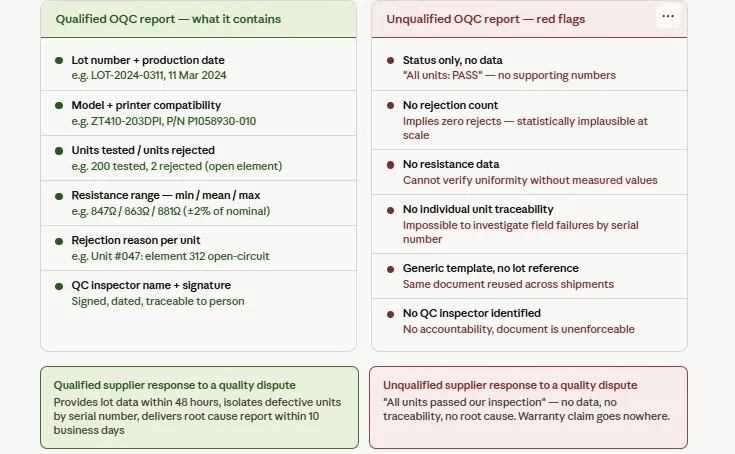
A supplier’s QC process determines the defect rate you absorb at incoming inspection. Suppliers with documented OQC (outgoing quality control) processes consistently deliver lower incoming defect rates than those relying on customer returns as their defect feedback mechanism.
What to ask: “What electrical tests do you perform on every unit before shipment? What is your outgoing defect rate for this model over the last six months? Can you provide a sample OQC report from a recent production lot?”
Minimum acceptable OQC process for thermal printheads:
- 100% electrical continuity test: every element in the resistor array tested for open-circuit condition. Pass criterion: zero open elements.
- Resistance uniformity measurement: individual element resistance within ±5% of nominal value across the full array. Pass criterion: 100% of elements within tolerance. Elements outside tolerance are replaced or the unit is rejected — not shipped with a notation.
- Visual inspection: overglaze surface, substrate edge integrity, electrode contact pad condition, connector pin alignment within ±0.5mm of nominal.
- ESD packaging: metallized anti-static bag with humidity indicator card, die-cut foam insert, sealed before leaving the test station.
What a good OQC report contains: Lot number, production date, model number, number of units tested, number of units rejected (and rejection reason), resistance range (min/max/mean across the lot), and the name of the QC inspector. A report that lists only “pass” without supporting data is not an OQC report — it is a shipping document with a QC label.
Outgoing defect rate benchmark: A well-controlled compatible printhead production line achieves outgoing defect rates below 0.3% on standard models. Rates above 1% indicate a process control problem that will produce recurring incoming quality failures regardless of the RFQ price.
Question 6: What Is Your Warranty and DOA Policy?
Warranty terms establish the supplier’s financial commitment to the quality claims they make during the sales process. Weak warranty terms signal low confidence in product reliability; clear, documented warranty terms signal operational maturity.
What to ask: “What is your warranty period? What is your DOA (dead on arrival) definition and claim process? What is your response time for warranty claims, and how are replacements shipped?”
Acceptable warranty structure for compatible thermal printheads:
- Warranty period: 12 months from shipment date, covering manufacturing defects under normal operating conditions
- DOA definition: units that fail electrical continuity test or produce missing dots on the first test print, reported within 14 days of delivery
- Claim process: written NCR (non-conformance report) with photo documentation of defective units; supplier response within 5 business days; replacement shipment within 10 business days of claim approval
- Replacement shipping: DHL or equivalent express for DOA claims; standard freight for warranty claims after the first 30 days
What warranty terms cannot cover: Printheads damaged by ESD during the buyer’s handling, physical damage from incorrect installation, chemical damage from non-approved cleaning agents, or wear from operating above rated parameters. A supplier who claims unlimited warranty covering all failure modes is misrepresenting the warranty scope — ask for the exclusions in writing.
Red flag: No written warranty documentation. Verbal warranty commitments from sales representatives are unenforceable. If the supplier cannot provide a one-page warranty terms document before the purchase order, the warranty does not exist in any practical sense.
Question 7: What Payment Terms Do You Offer, and How Do They Change Over Time?
Payment terms are a direct measure of the supplier’s financial confidence in their product and their assessment of buyer risk. Understanding the progression from first-order terms to established-account terms allows you to plan cash flow and use payment structure as a negotiation lever.
What to ask: “What are your payment terms for a first order at [target volume]? How do terms change after 3, 6, and 12 months of on-time payment history? Do you offer any pricing adjustment for higher deposit percentages?”
Typical payment term progression for China-sourced compatible printheads:
| Relationship Stage | Standard Terms | Negotiable Variation |
|---|---|---|
| First order | 50% deposit, 50% before shipment | 30/70 with trade reference |
| 3+ orders, on-time payment | 30% deposit, 70% before shipment | 20/80 after 6 months |
| 12+ months, annual volume >$50k | Net 30 open account | Net 45 with credit insurance |
| Framework contract, annual volume >$100k | Net 30–45 open account | L/C optional |
Using payment as a negotiation lever: Offering 50% deposit on a first order (versus the supplier’s standard 30%) in exchange for a 3–5% unit price reduction works when the supplier is a smaller manufacturer with limited working capital. The supplier receives $0.70 per dollar of order value before committing production capacity — reducing their financing cost. That saving is shareable. Larger, well-capitalized factories are less responsive to this lever.
What to avoid: Paying 100% upfront to a supplier without any verified track record. Full prepayment on a first order from an unverified supplier has no recovery mechanism if the supplier fails to deliver or delivers non-conforming product. The 30–50% deposit structure protects the buyer: the supplier absorbs the material cost risk if they do not ship; the buyer absorbs only the deposit if the supplier defaults.
Question 8: Can You Provide References from Existing Buyers in a Similar Application?
References are the only source of information about a supplier’s actual performance versus their claimed performance. A supplier who declines to provide references — citing confidentiality — is not protecting their customers; they are concealing performance data they prefer you not see.
What to ask: “Can you provide two or three references from existing buyers who purchase similar printhead models in similar volumes? I need a contact name and company, not just a logo or testimonial.”
How to evaluate the reference:
Contact each reference with these specific questions:
- “What printhead models do you source from this supplier, and in what volumes?”
- “What has your incoming defect rate been over the last 12 months?”
- “Have you had any lot rejection events? If so, how did the supplier respond?”
- “What is their typical lead time versus quoted lead time?”
- “Would you place a new order with them today?”
The answers to questions 3 and 5 are the most informative. Every supplier has quality incidents; the measure of a reliable supplier is their response when one occurs. A supplier whose reference describes a lot rejection handled with replacement shipment within 10 days and a root cause report is a qualified supplier who had a problem. A supplier whose reference describes an unresolved dispute is a disqualified supplier.
When references are genuinely unavailable: New suppliers — those who have been operating for less than 2 years or who have recently expanded into a new product category — will not have an established reference base. In this case, substitute with: factory audit documentation, third-party inspection reports from SGS or Bureau Veritas, and a smaller trial order at 20–30% of your intended volume before committing to full volume. Do not skip reference verification entirely; substitute it with equivalent evidence.
5 Red Flags That Disqualify a Supplier Regardless of Price
Red flag 1: Inability to identify the manufacturing source. If a supplier cannot — or will not — identify who manufactures the printheads they sell, they cannot guarantee lot-to-lot consistency. The price they quote is the only fixed element in the relationship; the quality is variable.
Red flag 2: Certificates without verifiable issuing body details. CE declarations without a notified body reference number, ISO certificates without an accreditation body name, or RoHS declarations without test lab details are fabricated documents. They are common in the compatible components market. Verify every certificate against the issuing body’s public registry before accepting it.
Red flag 3: Resistance to pre-shipment inspection. A supplier who objects to third-party PSI (pre-shipment inspection by SGS, Bureau Veritas, or equivalent) on orders above 200 units is concealing either a quality problem or a production shortcut. PSI costs $300–$600 per inspection visit — a supplier confident in their quality welcomes it as proof of conformance.
Red flag 4: Quoted lead times that do not account for production. A supplier quoting 3-day lead time on a model that requires 4 weeks to produce is either lying about stock availability or planning to source from a secondary factory without disclosing it. Ask specifically: “Is this model in stock at your warehouse, or will it be produced after my order is placed?” Get the answer in writing.
Red flag 5: No written documentation for any commitment. Warranty terms, payment terms, QC standards, and delivery schedules that exist only in email conversations from a sales representative have no contractual standing. A qualified supplier provides a formal quotation and purchase confirmation that references all agreed terms. If the supplier’s only documentation is a WeChat message or an unformatted email, the relationship has no enforcement mechanism.
How Hansprintec Meets Each Qualification Criterion
Hansprintec is a direct-source supplier of compatible and OEM-equivalent thermal printheads for Zebra, Honeywell, SATO, TSC, Datamax, Citizen, Videojet, Markem, Domino, Bizerba, Avery, CAB, Godex, Toshiba, and 20+ additional printer brands.
On Question 1 (manufacturer vs trader): Hansprintec operates as a direct factory-sourced supplier with fixed manufacturing partnerships — not a spot-market trading company. The manufacturing source for each printhead model is documentable and consistent across lots.
On Question 2 (certifications): CE, RoHS, and ISO documentation are provided with every shipment. Model-specific certification documentation is available on request before order placement. Browse the full printhead catalog for available models with certification status.
On Question 3 (capacity): Standard models for Zebra, Honeywell / Intermec, SATO, and Datamax are held in buffer stock. Lead time and allocation status for specific models is confirmed at quotation stage — not assumed from a website listing.
On Question 4 (sample policy): Production-lot samples are available for all catalog models. Sample units include electrical test data (resistance value per unit). Sample cost is credited against the first production order above MOQ. Sample lead time: 3–7 days for stocked models.
On Question 5 (OQC standards): 100% electrical continuity and resistance uniformity testing is performed on every unit before shipment. OQC reports with lot-level resistance data are provided with all shipments above 20 units.
On Question 6 (warranty): 12-month warranty from shipment date on all models. DOA claims accepted within 14 days with photo documentation. Written warranty terms available before order placement.
On Question 7 (payment terms): T/T 30% deposit for first orders; open account terms available after 3+ order history. Framework agreement pricing available for annual volumes above 200 units.
On Question 8 (references): Buyer references available on request for comparable order volumes and printer models. Contact the sales team at hansprintec.com to request references relevant to your specific application.
Product range available for qualification:
- Industrial label: Zebra printheads · SATO printheads · TSC printheads · Datamax printheads · Intermec printheads · Toshiba printheads · Godex printheads
- Receipt and retail: Citizen printheads · Avery printheads · Bizerba printheads
- Coding and marking: Videojet printheads · Markem printheads · Domino printheads
- Specialty: CAB printheads
- Accessories: platen rollers · cutters · thermal transfer ribbons
Submit a model list and monthly consumption estimate at hansprintec.com/products to receive a qualification package including pricing, sample availability, lead time confirmation, and certification documentation.
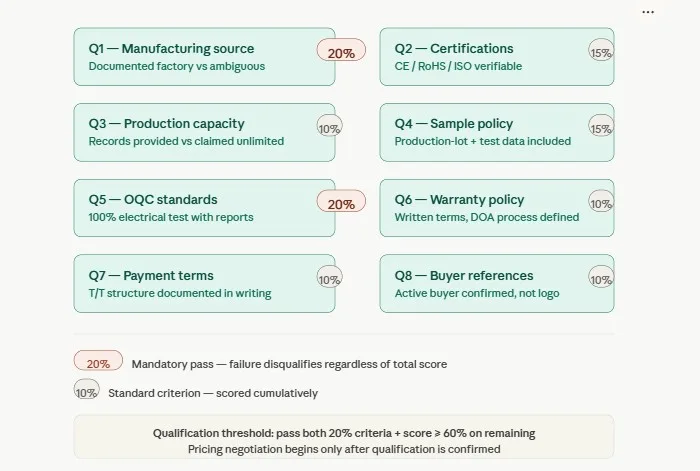
Supplier Qualification Scorecard
Use this framework to score each candidate supplier before making a sourcing decision:
| Criterion | Weight | Pass | Fail |
|---|---|---|---|
| Manufacturing source disclosed | 20% | Documented factory | Ambiguous or refused |
| Certifications verifiable | 15% | Certificate + issuing body confirmed | Logo only or unverifiable |
| Capacity documented | 10% | Production records provided | Claimed unlimited |
| Sample policy | 15% | Production-lot samples with test data | No samples or showroom units |
| OQC process documented | 20% | 100% electrical test with reports | Visual only or undocumented |
| Warranty in writing | 10% | Written terms with exclusions | Verbal only |
| Reference provided | 10% | Active buyer reference confirmed | Declined or testimonial only |
A supplier who fails any criterion marked at 20% weight is disqualified regardless of their score on other criteria. A supplier who passes all criteria with documented evidence is a qualified source — pricing negotiation can then proceed on a sound foundation.
FAQ
What is the single most important question to ask a thermal printhead supplier? Question 5 — OQC standards — has the highest predictive value for incoming quality. A supplier who performs 100% electrical continuity testing on every unit will deliver a fundamentally different incoming defect rate than one who relies on sampling or visual inspection. The answer to this question determines your IQC workload and warranty claim frequency more than any other factor.
How do I verify that a supplier’s printhead is actually compatible with my printer model? Physical sample testing in the target printer is the only definitive verification method. Request 3–5 production-lot samples, install them in the actual printer model and firmware version used in production, and run a minimum 500 linear meters of the production media type. Compatibility claims based on part number cross-references or specifications sheets are necessary but not sufficient — thermal profile matching between the printhead and the printer’s energy settings requires empirical testing.
Should I prefer a manufacturer or a trading company for printhead sourcing? Either is acceptable provided the supply chain is transparent. A trading company with a documented, fixed manufacturing partnership and full access to factory QC data is preferable to a manufacturer with opaque quality systems. The critical variable is traceability — can you identify the specific production lot, manufacturing date, and QC data for every unit you receive? If yes, the business model of the supplier is secondary to the traceability of the product.
How many suppliers should I qualify for thermal printhead sourcing? Maintain a minimum of two qualified suppliers for any printhead model that is critical to production continuity. Single-source dependency creates unacceptable supply risk — a factory shutdown, allocation constraint, or quality failure at your sole source halts production with no recovery option. A secondary qualified supplier — even if not actively ordering from them — provides the leverage to resolve quality disputes and the option to switch without a re-qualification cycle under pressure.
What is an acceptable incoming defect rate for thermal printheads? Zero tolerance for functional defects — open-circuit elements, resistance out of specification, and physical damage — at incoming inspection. An AQL 1.0 sampling plan means a lot with 1% defect rate has a roughly 50% probability of passing inspection; any supplier whose process produces a 1% defect rate is unacceptable for thermal printhead supply. Qualified suppliers operating well-controlled processes deliver incoming defect rates below 0.3% on standard models. If your IQC is consistently finding defects above 0.5% on incoming lots, the supplier’s OQC process is not performing as claimed.
